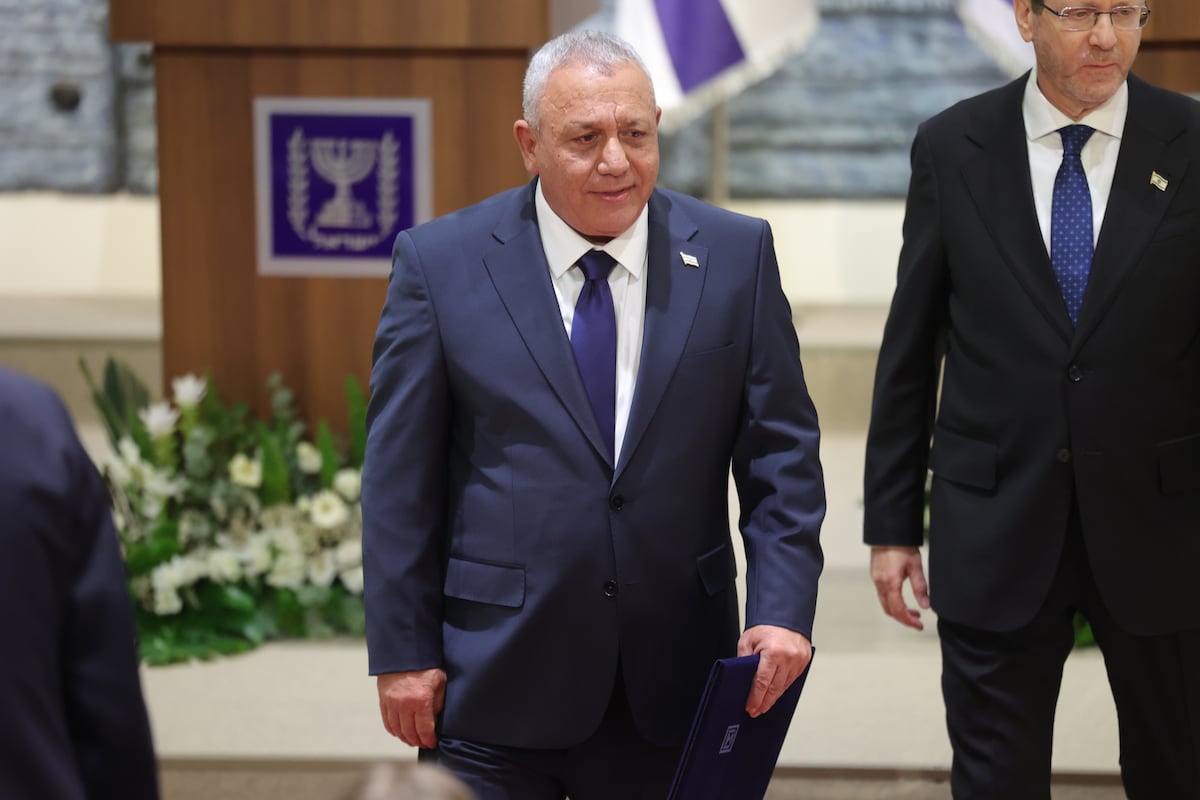
Gadi Eisenkot accepted the task of forming Israel's next government on Sunday at a ceremony at the president's residence in Jerusalem, striking a serious tone as he called on rival parties to make concessions. The former military chief of staff said the country is in a state of emergency that rules out "the privilege of prolonging the situation or entering an endless round of elections," according to EL PAÍS.
President Isaac Herzog handed Eisenkot the mandate after a week of consultations with parliamentary factions. Eisenkot's party, Yashar, finished second in the October 27 election, but a majority of factions recommended him for the job, EL PAÍS reports.
Why it matters
The mandate marks a potential end to four years in which Benjamin Netanyahu governed in alliance with ultranationalist and ultra-Orthodox partners. Eisenkot, who led the army from 2015 to 2019 while Netanyahu was prime minister, now has 28 days to assemble a coalition. If he fails, Herzog can extend the deadline by two weeks.
The difficulty was visible at the ceremony itself. Eisenkot's potential partners disagree sharply over whom to include in a government and, above all, whom to exclude. Every path available to him requires at least one party to break a campaign promise.
A warning about a 'point of no return'
Speaking after receiving the mandate, Eisenkot warned that continuing on the current course carries the risk of reaching a point of no return. He said reversing direction later would be very costly for Israeli society and the state.
He described an urgent need for new and substantial leadership — leaders who can be looked in the eye and trusted, and who safeguard the interests of all of Israel. He also lamented the country's diplomatic crisis and what he called a moment of vulnerability for its democracy, among the gravest in Israel's seven decades. "We have reached a dangerous point," he said, as reported by EL PAÍS.
Eisenkot urged parties to take "creative and extraordinary" decisions to establish what he called a national emergency government. He added that anyone who tries to sabotage its formation for personal reasons rather than substantive ones will be remembered by history as someone who failed to save Israel at a moment of emergency.
Herzog said Israel needs a good and stable government that serves the entire people, regardless of political leanings or population group. The president acknowledged that Likud was the largest vote-getter and said he had noted that during consultations. He explained that the mandate does not always go to the biggest party but to the candidate with the best chance of building a government, and that this has happened before in Israel's history.
The arithmetic behind the mandate
Six opposition parties recommended Eisenkot to the president, according to EL PAÍS. Alongside Yashar, they were Beyahad, led by former prime ministers Naftali Bennett and Yair Lapid; the left-wing Democrats of Yair Golán; and the secular right-wing Israel Beitenu of veteran former minister Avigdor Lieberman. Both Arab lists also backed Eisenkot, shoring up his candidacy and keeping the task from falling to Netanyahu.
Netanyahu received just 46 recommendations in the consultations — fewer than his current coalition with ultra-Orthodox and ultranationalist parties would suggest, because United Torah Judaism, which holds seven seats, abstained from recommending anyone.
Beyond his own bloc, Eisenkot could rely on the Arab parties, the ultra-Orthodox, a combination of both, or govern in a minority. He has also suggested he could draw on members of Likud or the religious nationalist camp if they accept his four conditions and his role as prime minister.
Those conditions, which he has repeated since the campaign, require accepting Israel's character as a Jewish and democratic state; mandatory military or national service for all citizens; respect for the principles and values of the Declaration of Independence; and defining Hamas as a terrorist organization that must hand over its weapons and end its control of roughly half of Gaza.
What to watch: whether Eisenkot can convert the recommendations into a working coalition within 28 days, and which of his potential partners blinks first on their campaign pledges.